
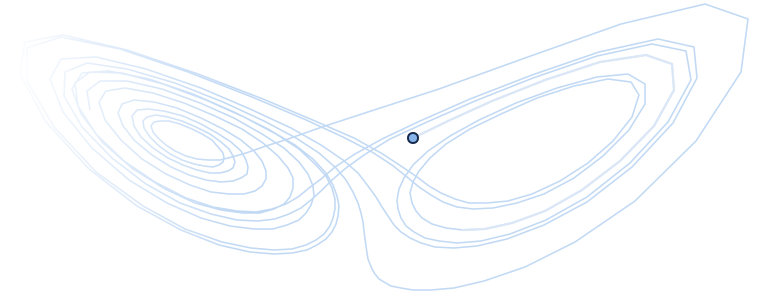
Neural coding
Temporal organization, cell assemblies, spike-train patterns, and neuronal communication.
Explore this field ↗Exploring how brains organize information across time, from the firing patterns of individual neurons to cognition, neural networks, and decision-making.
Explore the original essay in which Alessandro E. P. Villa articulated the neuroheuristic approach, connecting observation, modelling, hypothesis revision and transdisciplinary discovery.
Villa’s work connects neurophysiology, computational modeling, applied mathematics, information science, and the study of cognition. The neuroheuristic approach views these methods as mutually corrective rather than competing explanations.
Temporal organization, cell assemblies, spike-train patterns, and neuronal communication.
Explore this field ↗Nonlinear dynamics, synchronization, attractors, and biologically grounded neural-network models.
Explore this field ↗EEG, optical neuroimaging, attention, working memory, neuroeconomics, and translational studies.
Explore this field ↗The term joins the Greek roots for nerve and discovery. Villa’s November 2001 statement described an ongoing interaction between bottom-up experiments and top-down models, in which inquiry evolves as new evidence and methods change the questions themselves.
Read the intellectual historyA dynamic meeting ground for experiment, modeling, and the continual renewal of scientific hypotheses.
Editorial paraphrase of Villa’s 2001 The Neuro Heuristic paradigm; see original source.
From early studies of sensory neurophysiology and anatomical reconstruction to neural population dynamics, artificial neural networks, and decision neuroscience, Villa’s research follows the interaction of rigorous experimental observations with increasingly sophisticated explanatory models.
A renewed articulation of the neuroheuristic paradigm.
Read publication ↗Population activity and behavioral prediction.
Read publication ↗Villa’s historical welcome page described collaboration across scientific disciplines, cultural backgrounds, generations and languages. The legacy remains relevant to the neuroheuristic approach today.
Explore the historical principles“TRANSDISCIPLINARITY is a living word.”
From the legacy laboratory welcome page, welold.htm.