
Attentional capture, suppression and neural timing
How do unexpected events and task-irrelevant information gain access to cognitive processing—and how can attention be selectively controlled? NHRG combines temporally resolved electrophysiology, fast optical imaging and quantitative signal analysis to investigate mechanisms of attention.
Experimental and computational approaches
EEG and ERP
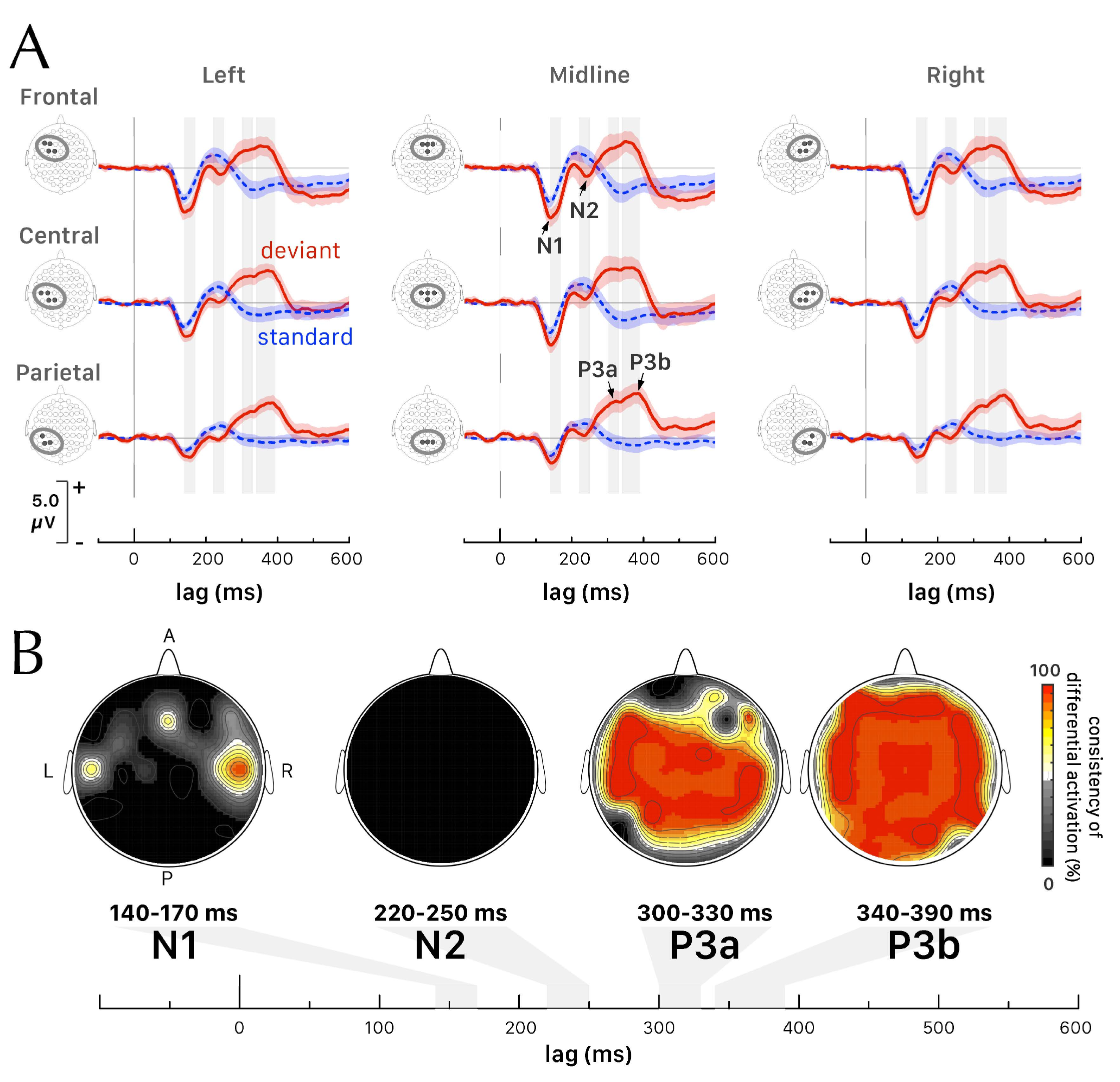
Quantification of event-related cortical responses and temporally resolved processing of standard versus unexpected sensory events.
Fast optical neuroimaging
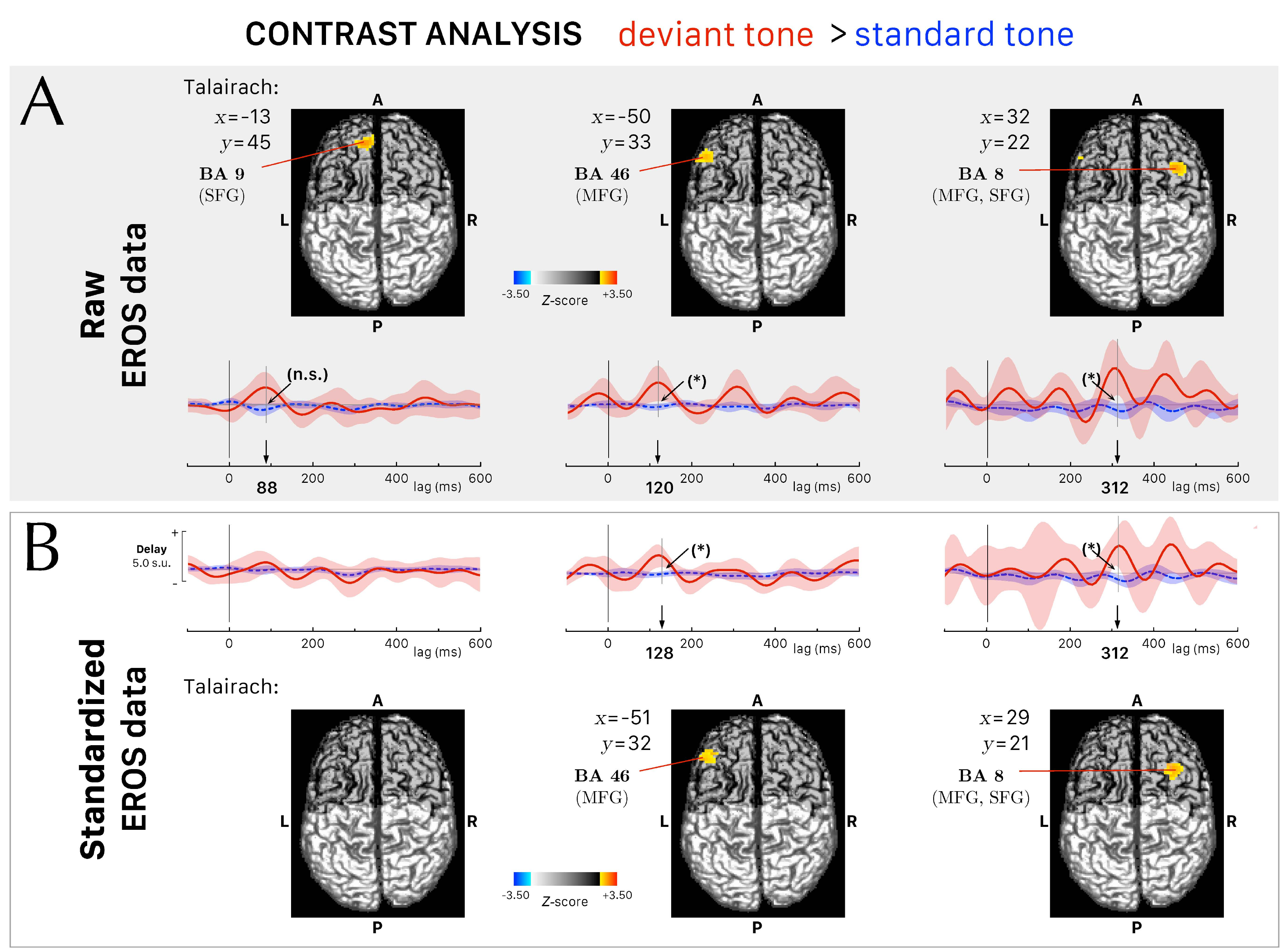
Optical signals provide complementary information on cortical responses, including regions in the dorsolateral prefrontal cortex.
Computational signal analysis
Waveform comparisons, spatiotemporal localization and quantitative analysis of neural and hemodynamic signals.
Visual-attention studies
The ongoing SNSF program studies the attraction and suppression of attention by visual stimuli.
Published EEG and EROS results from auditory-deviance research
Funded program and scientific interpretation
The ongoing research program Attraction and suppression of attention: Unravelling the Intricacies of Visual Capture extends the group’s investigation of attentional dynamics. The 2024 published auditory-deviance study demonstrated prefrontal involvement in processing unexpected sounds. The project’s current visual-attention hypotheses and future outcomes should be reported separately from completed auditory experiments.
Project period: March 2025–February 2029 (based on the grant details provided by NHRG).
Swiss National Science Foundation project record ↗Selected publications
Jaquerod, M. E., Knight, R. S., Lintas, A., & Villa, A. E. P. (2024). A Dual Role for the Dorsolateral Prefrontal Cortex (DLPFC) in Auditory Deviance Detection. Brain Sciences 14(10), 994.
doi:10.3390/brainsci14100994 ↗Dotare, M., et al. (2020). Attention Networks in ADHD Adults after Working Memory Training with a Dual n-Back Task. Brain Sciences 10(10), 715.
doi:10.3390/brainsci10100715 ↗Original published figures are reproduced with acknowledgement and links to their source articles. NHRG-supplied and openly licensed images are stored locally in this website.